Learn how small businesses can get found in AI search by testing it and making their online information clearer and easier to verify.
In this month’s issue of The Ripple Effect, Paula Zalba of Mill Town Media Group, a marketing specialist and Ripple member, shows how to see where your business stands when people ask AI for a local recommendation, and five moves you can make today.
If someone uses AI search to find a business in your area, would your business appear in the answer?
That is a question more small business owners need to ask. As shared in the October 2026 Ripple Effect, 45% of consumers now use AI to find local businesses, compared with 6% one year ago. Google’s share as a source for local business reviews is now 71%, down from 83%.
The first step is simple: ask AI about your own business.
Start With the Three-Minute AI Search Test
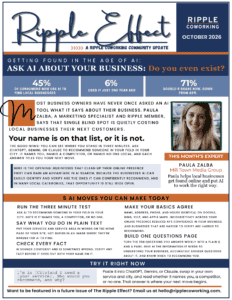 You can see where your business stands in about three minutes.
Ask ChatGPT, Gemini, or Claude to recommend someone in your field in your city. For a Daytona Beach business, try:
“I’m in Daytona Beach and I need a [your service]. Who would you recommend, and why?”
Then read the answer.
AI may name your business, name a competitor, or name no one local. Each result gives you information about what to investigate next.
Make Your Business Easier for AI to Understand
The October newsletter identifies four additional moves that can help businesses present clearer information online.
1. Make Your Business Basics Agree
Keep your name, address, phone number, and hours identical on Google, Bing, Yelp, and Apple Maps.
Inconsistency across your online presence reduces AI’s confidence in your business. Businesses that are harder to verify are harder to recommend.
2. Say What You Do in Plain Text
Put your services and service area in words on your website’s home page.
Do not bury that information in an image where it is harder for AI to find.
3. Build One Questions Page
Think about the questions you answer every week.
Turn the ten questions you answer weekly into a plain Q&A page. This gives AI information it can use to understand your business, accurately answer questions about it, and know when to recommend you.
4. Check Every Fact Before Publishing
AI sounds confident and is sometimes wrong.
Verify any fact before it goes out with your name on it.
Two Things You Can Do Today
Takeaway 1: Run the Three-Minute Test
Open ChatGPT, Gemini, or Claude and ask:
“I’m in Daytona Beach and I need a [your service]. Who would you recommend, and why?”
Read whether the answer names you, a competitor, or no one.
That answer is where your next move begins.
Takeaway 2: Check Your Basic Business Information
Look at your business information on Google, Bing, Yelp, and Apple Maps.
Check that your name, address, phone number, and hours are identical across those platforms.
Your Name Is on the List, or It Is Not
AI search gives small businesses another way to see how their online presence is being interpreted.
The process does not require guessing what AI knows about your business. Ask it directly.
Run the test, examine the answer, and use what you find to determine your next move.
About Paula Zalba
Paula Zalba is a marketing specialist and Ripple member at Mill Town Media Group. She helps local businesses get found online and put AI to work the right way.

